Introduction:
Welcome to the exciting world of social media marketing! In this article, we’ll explore the fundamentals of social media marketing and how you can harness the power of social media platforms to boost your marketing efforts.
A. Definition of social media marketing
Social media marketing is a strategic approach to promoting your products, services, or brand using various social media platforms. It involves creating and sharing engaging content, interacting with your audience, and utilizing the unique features and targeting options provided by these platforms.
B. Importance of leveraging social media platforms for marketing
Leveraging social media platforms for marketing offers numerous benefits.
- It allows you to tap into the vast user base and reach a wide audience, enabling you to connect with potential customers globally.
- Social media platforms provide an opportunity to engage directly with your audience, build relationships, and foster brand loyalty.
- These platforms offer valuable insights and analytics that help you understand your audience better and make data-driven decisions to optimize your marketing strategies.
C. Overview of the article’s purpose and structure
In this article, we aim to provide you with a step-by-step guide to social media marketing success. We’ll cover everything from understanding different social media platforms and setting marketing goals to building a strong online presence, engaging with your audience, and measuring your success. We’ll also explore social media advertising, compliance, and ethics, and share real-life examples to inspire and guide you along the way.
So, let’s dive in and unlock the potential of social media marketing together!
II. Understanding Social Media Platforms
A. Overview of popular social media platforms (e.g., Facebook, Instagram, Twitter, LinkedIn)
Social media platforms have revolutionized the way we connect and communicate. Let’s take a closer look at some of the most popular platforms:
Facebook: With over 2.8 billion monthly active users, Facebook is the largest social media platform. It offers a wide range of features such as profiles, pages, groups, and events, making it versatile for both personal and business use.
Instagram: Known for its visually-oriented nature, Instagram has gained immense popularity, especially among younger demographics. It focuses on sharing photos and videos, making it ideal for businesses in industries like fashion, beauty, travel, and food.
Twitter: Twitter is a microblogging platform that allows users to share short messages called “tweets.” It’s a real-time platform for news, updates, and conversations, making it valuable for businesses aiming to engage with their audience and stay current.
LinkedIn: LinkedIn is a professional networking platform that caters to businesses and professionals. It’s an excellent platform for B2B marketing, recruitment, and industry networking.
B. Comparison of platform strengths and demographics
Each social media platform has its strengths and attracts different demographics. Let’s explore their unique features and user demographics:
Facebook: Facebook offers a broad user base across various age groups and demographics. It’s suitable for businesses aiming for a wide reach and diverse audience. It provides robust advertising tools and advanced targeting options.
Instagram: Instagram primarily appeals to a younger audience, particularly those under 35 years old. Its visual nature makes it ideal for showcasing products, lifestyle content, and creative visuals. Instagram also offers features like Stories and IGTV for more interactive content.
Twitter: Twitter is a fast-paced platform, ideal for real-time updates, news, and engaging in conversations. It appeals to users looking for quick and concise information. It’s valuable for businesses seeking to engage with their audience, address customer concerns, and participate in trending discussions.
LinkedIn: LinkedIn is designed for professional networking, making it a valuable platform for B2B marketing, job recruitment, and industry thought leadership. It attracts professionals, executives, and businesses looking to establish professional connections and share industry-specific content.
C. Choosing the right platforms for your business
When selecting social media platforms for your business, consider your target audience and marketing goals. Here are some factors to consider:
Demographics: Identify the demographics that align with your target audience. Which platforms do they frequent the most?
Content-Type: Determine the type of content that best represents your business. Visual content may perform well on platforms like Instagram, while informative articles or industry insights may find a better audience on LinkedIn.
Business Goals: Align your choice of platforms with your business goals. If you want to generate leads and conversions, platforms like Facebook and Instagram offer strong advertising capabilities. If you’re focused on professional networking or B2B marketing, LinkedIn might be the best fit.
It’s not necessary to be present on every social media platform. Choose a few platforms that align with your target audience and marketing objectives, and invest your time and resources in creating engaging content and building a strong presence on those selected platforms.
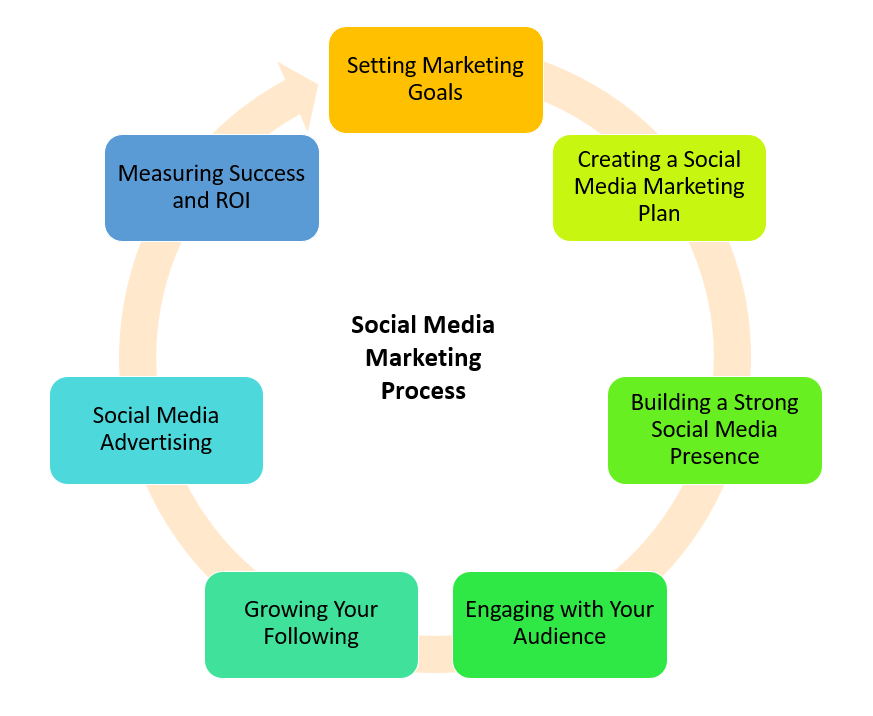
III. Setting Marketing Goals
A. Defining specific and measurable objectives
Setting clear and specific objectives is crucial for effective social media marketing. To ensure your goals are meaningful and actionable, consider the following:
Increase brand awareness:
Set a goal to increase your brand’s visibility and reach on social media platforms. This can be measured by the number of followers, impressions, or social media mentions.
Drive website traffic:
Aim to generate more traffic to your website through social media channels. Track the number of clicks, referral traffic, or conversions from social media sources.
Boost engagement:
Focus on increasing engagement with your audience, such as likes, comments, shares, or retweets. Engagement indicates the level of interest and interaction with your content.
Generate leads:
Set a goal to generate leads or capture email addresses through social media campaigns or gated content. Track the number of sign-ups or form submissions originating from social media.
Increase sales:
If your ultimate goal is to drive sales, set specific targets for revenue generated from social media marketing efforts. Measure the number of conversions or sales attributed to social media channels.
Each objective should be measurable, allowing you to track progress and evaluate the effectiveness of your social media marketing strategies.
B. Identifying target audience and buyer personas
Understanding your target audience is essential for crafting effective social media marketing strategies. Consider the following steps to identify your target audience and create buyer personas:
Demographics:
Define the demographic characteristics of your target audience, including age, gender, location, income level, and occupation.
Psychographics:
Understand the interests, values, attitudes, and behaviors of your target audience. This includes their motivations, preferences, and pain points.
Market research:
Conduct market research to gather insights about your audience. Utilize surveys, interviews, or social media analytics to understand their needs, challenges, and desires.
Buyer personas:
Create detailed buyer personas that represent different segments of your target audience. These personas should include information about their demographics, interests, goals, challenges, and how your product or service can meet their needs.
By developing clear buyer personas, you can tailor your social media content and messaging to resonate with your audience and effectively address their needs.
C. Aligning goals with social media marketing strategies
Once you have defined your marketing goals and identified your target audience, it’s time to align your goals with your social media marketing strategies:
Content creation:
Develop content that aligns with your objectives and is tailored to resonate with your target audience. For example, if your goal is to increase engagement, focus on creating interactive and shareable content like polls, contests, or user-generated content campaigns.
Platform selection:
Choose social media platforms that align with your goals and target audience. Different platforms have unique features and demographics, so select the ones that best suit your objectives and allow you to reach your desired audience effectively.
Messaging and tone:
Craft your social media messaging and tone to resonate with your target audience’s preferences and values. Use language, visuals, and storytelling techniques that connect with them on a personal level.
Call-to-action (CTA):
Include clear and compelling CTAs in your social media posts and campaigns to guide your audience toward the desired action. This can include visiting your website, making a purchase, subscribing to a newsletter, or filling out a form.
By aligning your goals with your social media marketing strategies, you ensure that every action you take on social media contributes to the overall success of your marketing efforts. Regularly evaluate your strategies and make adjustments as needed to stay on track and achieve your objectives.
IV. Creating a Social Media Marketing Plan
A. Conducting a competitive analysis
Before diving into your social media marketing efforts, it’s essential to conduct a competitive analysis. This analysis allows you to understand what your competitors are doing on social media and identify opportunities for differentiation. Consider the following steps:
- Identify competitors: Identify your main competitors in the industry and examine their social media presence.
- Analyze their social media channels: Study your competitors’ social media profiles, content, engagement levels, and overall strategy. Look for patterns, successful campaigns, and areas where they may be lacking.
- Assess audience engagement: Analyze how your competitors engage with their audience, respond to comments and foster relationships. Look for strategies that resonate well with their audience.
- Identify gaps and opportunities: Identify areas where your competitors may be lacking or areas where you can differentiate yourself. This can help you identify opportunities to stand out and provide unique value to your audience.
B. Developing a content strategy
A well-defined content strategy is the backbone of successful social media marketing. It ensures that your content aligns with your goals, resonates with your target audience, and maintains consistency. Here are key steps to develop your content strategy:
Choosing content types (e.g., articles, videos, infographics)
Consider the content types that best suit your target audience and objectives. Some common content types include:
- Articles and blog posts: Informative and educational content that showcases your expertise and provides value to your audience.
- Videos: Engaging and visually appealing content that can include tutorials, product demos, behind-the-scenes footage, or customer testimonials.
- Infographics: Visual representations of information or data that are easily shareable and visually appealing.
- Images and visuals: High-quality images, photographs, or graphics that capture attention and showcase your brand or products effectively.
- Polls, quizzes, and interactive content: Engage your audience through interactive content that encourages participation and provides insights into their preferences.
Planning content themes and topics
Identify the key themes and topics that resonate with your target audience and align with your brand. Consider their pain points, interests, and aspirations. Your content should provide solutions, valuable information, inspiration, or entertainment. Create a content calendar that outlines the topics, key messages, and target posting dates to ensure a consistent flow of content.
Establishing a content calendar
A content calendar helps you stay organized and ensures a consistent presence on social media. Outline the dates and times for each planned content piece, including captions, visuals, and relevant hashtags. It helps you maintain a consistent posting schedule, avoid content gaps, and plan ahead for special events or promotions.
C. Integrating social media with overall marketing efforts
To maximize the impact of your social media marketing, it’s essential to integrate it with your overall marketing efforts. This ensures consistency across all channels and maximizes the reach of your messaging. Consider the following strategies:
Branding and messaging:
Ensure that your social media branding, tone, and messaging align with your overall brand identity and marketing messaging.
Cross-promotion:
Promote your social media channels on your website, email newsletters, and other marketing collateral. Encourage your existing customers and contacts to connect with you on social media.
Linking to website and landing pages:
Include links to your website and relevant landing pages in your social media profiles, posts, and ads to drive traffic and conversions.
Consistent campaigns:
Align your social media campaigns with your overall marketing campaigns. Leverage social media to amplify your campaigns and create a cohesive experience for your audience.
By integrating social media with your overall marketing efforts, you create a seamless and unified brand experience for your audience, increasing the effectiveness of your marketing strategies.
To regularly review and adjust your social media marketing plan based on the insights you gather from analytics and audience feedback. Adapt your content strategy, posting schedule, and overall approach as needed to stay relevant and achieve your marketing goals.
V. Building a Strong Social Media Presence
A. Optimizing social media profiles
To build a strong social media presence, it’s important to optimize your social media profiles. These profiles serve as the first impression of your brand on social media platforms. Consider the following aspects:
Creating compelling bios and descriptions
Craft a captivating and concise bio or description that effectively communicates your brand’s essence, values, and unique selling points. Use language that resonates with your target audience and showcases your brand’s personality. Highlight key benefits or features that differentiate your business from competitors.
Choosing profile and cover images
Select high-quality profile and cover images that represent your brand visually. Use your logo or a visually appealing image that reflects your brand’s identity. Ensure that the images are appropriately sized for each platform to maintain clarity and professionalism.
Including relevant links and contact information
Include links to your website, landing pages, or other important online assets in your social media profiles. This makes it easy for users to access more information about your brand or take desired actions. Additionally, provide contact information such as email or phone number to facilitate direct communication with your audience.
B. Developing a consistent brand voice and tone
Consistency is key to building a strong social media presence. Develop a consistent brand voice and tone that aligns with your brand identity and resonates with your target audience. Whether your tone is casual, informative, playful, or professional, ensure it remains consistent across all your social media interactions. Consistency helps to establish brand recognition and builds trust among your followers.
C. Implementing effective visual design elements
Visuals play a crucial role in social media marketing. Implement effective visual design elements to enhance your brand’s presence:
Consistent colors: Use a consistent color palette that aligns with your brand identity. Incorporate these colors in your visuals, including images, graphics, and backgrounds, to create a visually cohesive and recognizable brand.
Fonts and typography: Choose fonts that match your brand personality and are easy to read. Consistency in font usage across your posts and visuals reinforces your brand’s visual identity.
Brand elements: Integrate your brand elements, such as logos or watermarks, into your visuals. This helps to reinforce your brand and ensure that your content is easily recognizable as yours.
D. Utilizing hashtags and keywords
Hashtags and keywords help increase the discoverability of your social media content. Research and use relevant hashtags and keywords in your posts to expand your reach and attract users who are interested in the topics you’re discussing. However, ensure that the hashtags and keywords you use are relevant and align with your content to attract the right audience and maintain authenticity.
Building a strong social media presence takes time and consistent effort. Regularly review and update your profiles, visuals, and messaging to ensure they reflect your brand’s evolution and resonate with your audience. Stay engaged with your followers, respond to their comments and messages, and consistently deliver valuable content to foster meaningful connections and grow your social media presence.
VI. Engaging with Your Audience
Engaging with your audience is a vital aspect of social media marketing. By actively interacting and building relationships with your followers, you can create a loyal community and foster brand advocacy. Here are some key strategies for engaging with your audience:
A. Responding to comments and messages promptly
Make it a priority to respond to comments and messages from your audience in a timely manner. Show appreciation for positive feedback, address any concerns or inquiries, and provide helpful responses. By engaging in conversations, you demonstrate that you value your audience’s opinions and actively listen to their feedback.
B. Encouraging user-generated content and participation
User-generated content is a powerful way to engage your audience and showcase their experiences with your brand. Encourage your followers to share their stories, photos, or reviews related to your products or services. Acknowledge and amplify their content by reposting or featuring it on your social media platforms. This not only encourages participation but also builds a sense of community and strengthens the connection between your brand and your audience.
C. Running contests and giveaways
Contests and giveaways are effective engagement strategies that generate excitement and incentivize participation. Organize contests that encourage your audience to engage with your brand by liking, commenting, sharing, or creating content related to your products or services. Offer attractive prizes that align with your target audience’s interests. This fosters enthusiasm and increases brand visibility as participants spread the word about the contest to their networks.
D. Engaging in discussions and starting conversations
Social media is a platform for meaningful conversations. Initiate discussions by posing thought-provoking questions, seeking opinions, or soliciting feedback from your audience. Respond to comments on your posts and actively engage in discussions related to your industry or niche. This demonstrates your expertise, builds rapport with your audience, and encourages them to actively participate in conversations.
Here is an example for you. Let’s say you manage the social media accounts for a fitness brand. You receive a comment on one of your posts from a follower named Sarah, who shares her personal fitness journey and how your brand has positively impacted her life. Respond promptly, thanking Sarah for sharing her story and expressing your appreciation for her support. Encourage her to continue her fitness journey and offer personalized advice or resources. By engaging with Sarah and celebrating her achievements, you not only strengthen her connection with your brand but also inspire other followers to share their stories.
Remember, genuine and authentic engagement is key. Take the time to listen, understand, and respond thoughtfully to your audience. Engage in conversations, offer support, and provide value through your interactions. By fostering a community and making your audience feel valued, you’ll create a strong brand following and increase the likelihood of turning your followers into loyal customers.
VII. Growing Your Following
Growing your social media following is crucial for expanding your reach and increasing brand visibility. Let’s explore effective strategies for attracting and engaging new followers:
A. Using targeted advertising and sponsored content
Utilize targeted advertising and sponsored content to reach a specific audience and expand your following. Platforms like Facebook, Instagram, and LinkedIn offer robust advertising options that allow you to narrow down your target audience based on demographics, interests, and behaviors. Craft compelling ad campaigns with engaging visuals and persuasive copy that resonate with your target audience and encourage them to follow your social media accounts.
B. Implementing organic growth strategies
Organic growth strategies help you attract followers through non-paid means. Here are some effective organic growth strategies:
Cross-promotion with other accounts
Collaborate with complementary brands or accounts that share your target audience but are not direct competitors. Engage in cross-promotion by featuring each other’s content, mentioning one another in posts, or conducting joint campaigns. This exposes your brand to a new audience, increasing the chances of gaining new followers.
Collaborating with influencers
Partner with influencers or micro-influencers who have a significant following within your target audience. Influencers can help amplify your brand’s message, reach their engaged audience, and encourage their followers to follow your social media accounts. Choose influencers whose values align with your brand and whose audience matches your target demographic.
Utilizing user-generated content
User-generated content (UGC) is a powerful tool for growth and engagement. Encourage your followers to create and share content featuring your products or services. Repost and credit their content, showcasing their creativity and loyalty to your brand. UGC not only attracts new followers but also fosters a sense of community and authenticity around your brand.
C. Leveraging analytics to identify and reach new audiences
Take advantage of social media analytics to gain insights into your current audience and identify potential new audiences. Study metrics like demographics, engagement rates, and reach to understand who is interacting with your content. Use these insights to refine your targeting and content strategies, ensuring your messaging reaches the right people. Additionally, explore audience insights tools provided by social media platforms to discover new audience segments that align with your target market.
By combining targeted advertising, organic growth strategies, and data-driven insights, you can effectively grow your social media following. Remember to consistently analyze your results, adapt your strategies based on feedback, and maintain an active and engaging presence on your social media platforms. Growing your following takes time and effort, but with a well-executed plan, you’ll see your audience expand and your brand presence flourish.
VIII. Measuring Success and ROI
Measuring the success of your social media marketing efforts is essential to understand what’s working, make data-driven decisions, and demonstrate the return on investment (ROI) to stakeholders. Let’s explore key steps for measuring success and tracking ROI:
A. Defining key performance indicators (KPIs)
Start by defining specific key performance indicators (KPIs) that align with your social media marketing goals. Some common KPIs include:
Reach: Measure the number of people who see your social media content. This can include metrics like impressions, followers, or reach.
Engagement: Assess how your audience interacts with your content. Track metrics like likes, comments, shares, or retweets to gauge engagement levels.
Click-through rate (CTR): Measure the percentage of users who click on a link in your social media post or ad to visit your website or landing page.
Conversion rate: Track the percentage of users who take a desired action, such as making a purchase, filling out a form, or subscribing to a newsletter, after interacting with your social media content.
B. Tracking and analyzing social media metrics
Utilize social media analytics tools provided by platforms or third-party software to track and analyze your social media metrics. Some key metrics to monitor include:
Platform-specific metrics: Each platform offers unique metrics like post reach, engagement rate, profile visits, and audience demographics. Track these metrics to assess the performance of your social media efforts on each platform.
Link tracking: Use UTM parameters or link tracking tools to monitor the traffic and conversions generated from social media. This helps you attribute specific actions to your social media marketing efforts.
Audience insights: Explore audience demographics, interests, and behavior data to gain insights into your target audience’s preferences and behaviors. This information can guide content creation and targeting strategies.
C. Adjusting strategies based on data insights
Regularly review your social media metrics and data insights to identify trends, patterns, and areas for improvement. Use these insights to make data-driven decisions and adjust your social media strategies accordingly.
For example:
If you notice that certain types of content generate higher engagement, focus on creating more of that content.
If you find that your audience engages more during specific days or times, optimize your posting schedule to maximize reach and engagement.
If a particular platform is driving a higher conversion rate, allocate more resources to that platform to amplify your results.
D. Calculating return on investment (ROI)
To calculate your social media ROI, compare the cost of your social media marketing efforts to the revenue generated as a result. Consider the following steps:
Assign a monetary value to social media outcomes:
To assign a monetary value to social media outcomes, businesses determine the worth of each conversion or desired action in terms of revenue or profit. This process involves actively evaluating the financial significance of every action, allowing them to gauge the impact of their social media efforts, make informed decisions, and optimize resource allocation for maximum business growth.
Calculate costs:
When assigning a monetary value to social media outcomes, it is crucial to consider all associated costs. This includes expenses related to content creation, running advertisements, hiring social media managers, or utilizing social media management tools. By accurately calculating these costs, businesses can have a comprehensive understanding of their investment in social media efforts.
Track revenue from social media:
It is essential to track and attribute the revenue generated directly from social media activities. This can be achieved by implementing trackable links, unique promo codes, or campaign-specific landing pages. By monitoring and accurately attributing revenue to social media, businesses can gain insights into the direct impact of their social media strategies on their bottom line.
Calculate ROI:
ROI (Return on Investment) is a vital metric that helps businesses assess the effectiveness and profitability of their social media endeavors. To calculate ROI, subtract the total costs from the revenue generated and divide it by the total costs. Multiply the result by 100 to obtain the ROI percentage. This percentage indicates the return on each dollar invested in social media, enabling businesses to evaluate the success and efficiency of their social media campaigns.
By regularly measuring your social media metrics, adjusting strategies based on insights, and calculating ROI, you can optimize your social media marketing efforts, improve performance, and demonstrate the value of social media to your organization.
IX. Social Media Advertising
A. Overview of different advertising options on major platforms
Major social media platforms offer a variety of advertising options to help businesses reach their target audience effectively. Here’s an overview of advertising options on popular platforms:
Facebook Ads: Facebook provides a robust advertising platform with various ad formats such as image ads, video ads, carousel ads, and collection ads. It offers advanced targeting options based on demographics, interests, behaviors, and custom audiences.
Instagram Ads: Instagram offers advertising options that seamlessly integrate with users’ feeds and Stories. Ad formats include photo ads, video ads, carousel ads, and Story ads. You can leverage Facebook’s targeting capabilities to reach your desired audience on Instagram.
Twitter Ads: Twitter offers promoted tweets, promoted accounts, and promoted trends to help businesses increase their reach and engagement. Targeting options include interests, keywords, demographics, and tailored audiences.
LinkedIn Ads: LinkedIn provides advertising options to target professionals and businesses. Ad formats include sponsored content, sponsored InMail, text ads, and dynamic ads. Targeting options include job titles, industries, company size, and LinkedIn member attributes.
B. Targeting options and audience segmentation
Social media advertising platforms offer sophisticated targeting options and audience segmentation capabilities. You can narrow down your target audience based on demographics, interests, behaviors, and even specific custom audience lists. Some targeting options include:
- Demographics: Target users based on age, gender, location, language, education, and more.
- Interests: Reach users who have expressed interest in specific topics, pages, or behaviors.
- Behaviors: Target users based on past behaviors, such as purchase history, device usage, or engagement with certain content.
- Custom audiences: Upload customer lists or create custom audiences based on website visitors, app users, or engagement with your social media accounts.
By utilizing precise targeting options, you can ensure your ads reach the right people, increasing the effectiveness of your campaigns.
C. Creating compelling ad campaigns
To create compelling ad campaigns, consider the following tips:
- Clear objectives: Define your campaign goals and align them with your overall marketing strategy.
- Compelling visuals: Use high-quality visuals that catch the audience’s attention and align with your brand’s visual identity.
- Persuasive copy: Craft engaging and concise ad copy that clearly communicates the value proposition and encourages action.
- Call-to-action (CTA): Include a clear and compelling CTA that prompts users to take the desired action, such as “Shop Now,” “Sign Up,” or “Learn More.”
- A/B testing: Experiment with different ad variations, including visuals, copy, CTAs, and targeting options, to identify the most effective combinations.
D. Monitoring and optimizing ad performance
Monitor and analyze the performance of your ad campaigns to optimize their effectiveness:
- Track key metrics: Monitor metrics such as impressions, reach, engagement, click-through rates, conversion rates, and cost per acquisition to gauge performance.
- Test and iterate: Continuously test and iterate your ad campaigns based on the insights gathered. Adjust targeting, ad copy, visuals, and CTAs to improve performance.
- Budget optimization: Regularly review and optimize your ad budget to allocate resources effectively and maximize your return on investment.
- Conversion tracking: Set up conversion tracking to measure the impact of your ads on actual conversions or sales. This helps you understand the true ROI of your social media advertising efforts.
By monitoring and optimizing your ad performance, you can refine your strategies, improve results, and make data-driven decisions to achieve the best possible return on your advertising investment.
X. Compliance and Ethics in Social Media Marketing
A. Understanding legal and regulatory requirements
When engaging in social media marketing, it’s crucial to understand and comply with legal and regulatory requirements. Some key considerations include:
- Sponsored content: Disclose partnerships and paid relationships to ensure transparency and compliance with advertising guidelines.
- Copyright and intellectual property: Respect intellectual property rights when using images, videos, or other content in your marketing materials.
- Data protection: Adhere to data protection laws and obtain necessary permissions before using customer data for marketing purposes.
B. Respecting user privacy and data protection
Respect user privacy and protect their data to maintain trust and build a positive reputation. Consider the following practices:
- Obtain consent: Seek explicit consent from users before collecting, using, or sharing their personal information.
- Data security: Implement measures to safeguard user data and prevent unauthorized access or breaches.
- Privacy policies: Clearly communicate your privacy policies, outlining how user data is collected, used, and protected.
C. Maintaining transparency and authenticity
Transparency and authenticity are essential in social media marketing. Foster trust and credibility by:
- Clearly disclosing sponsored content and paid partnerships to avoid misleading or deceptive practices.
- Engaging in genuine conversations with your audience, responding to comments, and addressing concerns promptly.
- Avoiding false or exaggerated claims about your products or services.
- By upholding compliance and ethical practices in your social media marketing efforts, you build trust, maintain a positive brand image, and foster long-term relationships with your audience.
XI. Case Studies and Success Stories
Let’s explore a couple of examples of successful social media marketing campaigns:
Case 1: Green Bites
A local restaurant, Green Bites, leveraged social media to boost their brand awareness and customer engagement. They shared behind-the-scenes videos showcasing their farm-to-table approach, engaged with followers through polls and questions, and encouraged customers to share their dining experiences. The result was increased foot traffic, higher customer engagement, and positive reviews, positioning Green Bites as a go-to restaurant in their area.
Case 2: Trendy Threads
Case Study: A fashion e-commerce brand, Trendy Threads, ran a targeted Facebook and Instagram ad campaign to promote their new collection. They utilized precise audience targeting, engaging visuals, and compelling copy. By monitoring the campaign closely and optimizing based on data insights, Trendy Threads achieved a significant increase in website traffic, a high conversion rate, and a positive return on their advertising investment.
These case studies demonstrate the importance of understanding your target audience, creating compelling content, and utilizing targeted advertising options to achieve success in social media marketing. By adopting strategies tailored to your business, monitoring performance, and making data-driven adjustments, you can achieve impressive outcomes and drive tangible results.
XII. Conclusion
Congratulations! You’ve gained valuable insights into social media marketing, including leveraging platforms, setting goals, engaging with your audience, measuring success, and maintaining compliance and ethics. By implementing the strategies discussed and continuously adapting to evolving trends, you can unlock the full potential of social media marketing to engage and convert customers.
Social media marketing is an ongoing journey that requires dedication, creativity, and an understanding of your audience. Stay informed about new features and emerging platforms, remain authentic and transparent, and consistently evaluate your performance to optimize your strategies.
Embrace the power of social media marketing and enjoy the exciting opportunities it brings to grow your brand and connect with your audience. Best of luck on your social media marketing journey!
Take the next step towards
achieving your digital marketing goals.